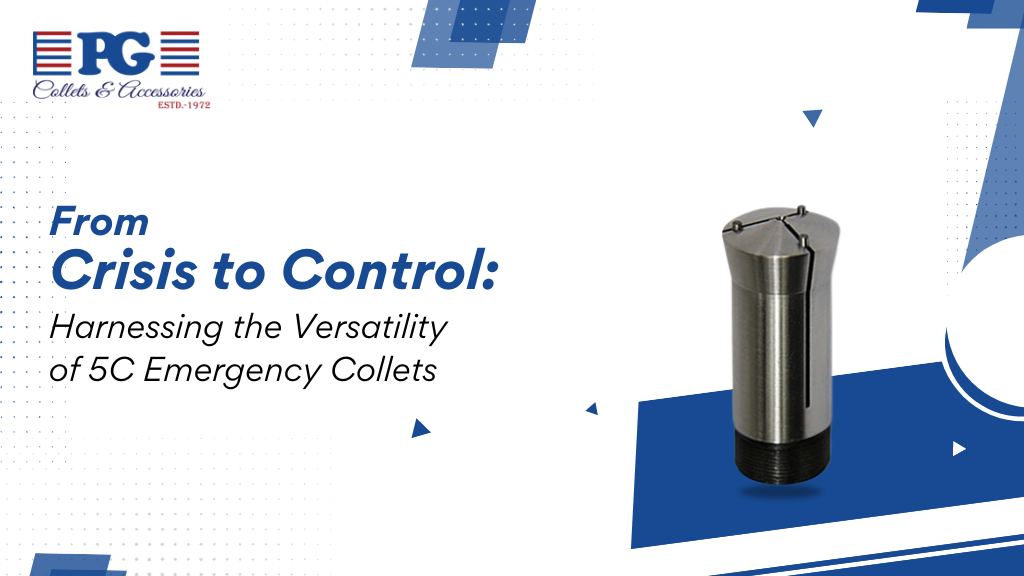


In the fast-paced world of machining, precision and efficiency aren’t luxuries—they’re lifelines. One of the most overlooked but critical choices machinists make every day is between the best 5C Emergency Collet and a standard collet. At first glance, the difference might seem minor, but in reality, it can help to your part quality, machine uptime, and ultimately, your profitability.
Every minute your machine sits idle is money lost. Choosing the wrong collet could turn a quick changeover into a costly delay.
In this guide, we’ll break down the critical differences between a 5C Emergency Collet and a standard collet, showing you exactly when each should take centre stage in your shop.
Understanding the Basics: What’s the Difference?
Before diving into applications, it’s essential to understand what sets these collets apart.
Standard Collets
- Precision Ground: Designed for specific diameters, ensuring tight tolerances.
- Ready to Use: No additional machining is required.
- Best for Repeated Jobs: Perfect when you consistently work with the same part size.
5C Emergency Collets
- Machinable Surface: Often made from soft steel, brass, or plastic—ready for custom boring to match unique part shapes or diameters.
- Versatility First: One collet can be adapted for multiple unique jobs.
- Quick Adaptation: Ideal for one-off parts, irregular shapes, or non-standard sizes.
Where standard collets excel in repetition and speed, they shine in flexibility and problem-solving.
The Critical Differences That Impact Your Workflow
1. Precision vs. Adaptability
- Standard Collet: Offers repeatable accuracy for high-volume, uniform parts.
- 5C Emergency Collet: Allows on-the-fly customization, which is crucial when precision must meet unusual shapes or sizes.
2. Changeover Speed
- Standard collets save time when switching between standard jobs.
- A 5C Emergency Collet might require initial machining, but it can dramatically reduce downtime for future runs of custom parts.
3. Downtime Costs
Here’s where the choice truly matters.
If you choose a standard collet for a custom job, you might spend hours searching for a matching size or ordering one—hours your machine sits idle. On the other hand, a 5C Emergency Collet can be machined in minutes to get production back on track.
When to Use a 5C Emergency Collet
A 5C Emergency Collet is your go-to in scenarios like:
- Prototyping: When you’re developing a part and specs might change mid-process.
- Irregular Shapes: Holding hexagonal, square, or custom-profile workpieces.
- Non-Standard Diameters: When stock size doesn’t match your existing collets.
- One-Off Repairs: Emergency jobs where speed trumps everything.
In these situations, its flexibility outweighs the time needed for initial boring. The same principles apply to other sizes like the 16c Emergency Collet and 173e collet for different spindle setups.
When Standard Collets Win the Day
Standard collets still rule when:
- You’re running long production batches of uniform parts.
- Tolerance is critical and repeatability is non-negotiable.
- Changeovers need to be nearly instantaneous.
For these jobs, the pre-ground precision of a standard collet delivers accuracy without extra prep work.
Why the Right Choice Impacts More Than Convenience
Too many shops see collet choice as a convenience issue—something to speed up or slow down a setup. In reality, your decision affects:
- Surface Finish: An improper grip can cause chatter and marks.
- Tool Life: Poor workholding can lead to vibration and wear.
- Machine Uptime: The wrong choice can stall production for hours.
- Operator Efficiency: Constant adjustments waste skilled labor.
At PG Collets, we’ve seen how the right collet choice can transform a shop floor’s productivity. Whether it’s a 5C Emergency Collet, 16C Emergency Collet, or 173e collet, matching the collet to the task is the smartest investment you can make.
Quick Decision Guide: 5C Emergency Collet vs. Standard Collet
| Scenario | Best Choice | Why |
| Scenario | Best Choice | Why |
|---|---|---|
| High-volume, identical parts | Standard Collet | Speed and repeatable accuracy |
| One-off, irregular part | 5C Emergency Collet | Machinable to exact shape |
| Prototyping with evolving specs | 5C Emergency Collet | Adaptable during process |
| Emergency repair job | 5C Emergency Collet | Fast customization to resume production |
| Tight tolerance, uniform shape | Standard Collet | No prep required, precision built-in |
The Overlooked Role of Secondary Sizes
While 5C Emergency Collets dominate many setups, don’t overlook 16c Emergency Collets for larger lathes or the 173e collet for specialty machines. Each brings the same flexibility benefits to its respective size class, ensuring your workholding strategy covers every machine on your floor.
Final Thoughts: Your Collet, Your Competitive Edge
Choosing between a standard collet and a 5C Emergency Collet isn’t just a matter of convenience—it’s about safeguarding precision, slashing downtime, and keeping production flowing. In a competitive machining environment, the right collet selection is as critical as the cutting tool itself.
If you’re ready to optimize your workholding strategy, PG Collets offers a full range of 5c Emergency Collets, 16c Emergency Collets, and 173e Collets—all built for the demands of modern machining.
Don’t let your machine sit idle—equip it with the collets that keep you ahead.
Explore PG Collets’ full range today.