
PG Collets - Quality Collets Manufacturers and Exporters in India and Abroad
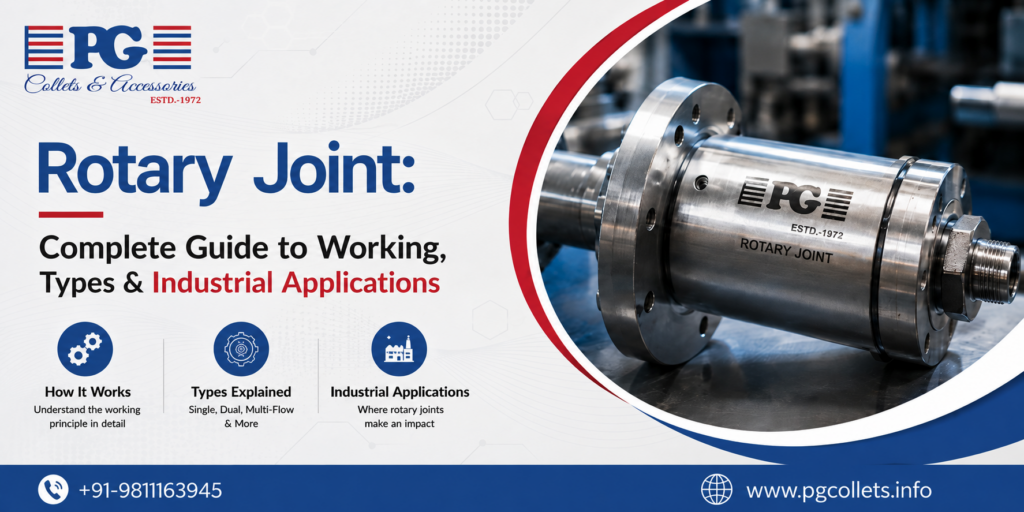
In today’s industrial equipment, it is necessary to have continuous rotation and assured fluid transfer for efficient production. A Rotary Joint is one of the most important mechanical elements which allows steam, water, air, oil or other fluid to flow from a stationary source to rotating equipment without leaking.
In industries such as manufacturing, textile processing, paper making, food processing or CNC machines, knowing how a Rotary Joint works can have a positive impact on machine performance, maintenance costs, and operational reliability. In this comprehensive guide, we will delve into its operation, various models, essential characteristics, its applications in the industry, and the advantages of investing in the appropriate Rotary Joint.
A Rotary Joint is a precision engineered component that is used to move fluid from fixed pipes to rotating parts of machinery. It forms a closed connection allowing rotation without any interruption of fluid flow.
Typically, these joints are made of high strength stainless steel, carbon steel, brass, or special alloys depending on the operating environment. They provide excellent sealing to prevent leakage, have a low friction coefficient and will provide the long lifespan required in challenging industrial environments.
For all of these benefits, Rotary Joints have become an indispensable part of many industrial manufacturing processes.
A Rotary Joint’s working principle is simple and yet very effective. One end is fixed and attached to the fluid source, the other is moving with the machine shaft or cylinder.
Precision seals keep the joint tight and provide smooth rotational motion inside the joint. Bearings help to hold the rotating assembly in place, minimizing wear and guaranteeing consistent performance under different speeds and pressures.
This effective system makes Rotary Joints suitable for machines with long production runs.
The Rotary Joint can be designed differently for various industries depending on the type of fluid, pressure, temperature and machine configuration.
Steam Rotary Joints are made for use at high temperatures where heated rollers or cylinders must be continuously supplied with steam.
Common applications:
These joints are used to provide cooling water to rotating equipment for temperature control and to enhance machine performance.
They are employed in a wide range of plastic molding, steel processing and printing machinery applications.
Air Rotary Joints are used to route compressed air to rotating tools and automated equipment. They are reliable and ensure constant pressure when operating.
Common applications:
A Rotary Joint with multiple passages means that different fluids can flow through different internal passages at the same time. Water, air, and hydraulic oil can flow from one joint to the other without mixing, for instance.
This design is commonly used in advanced automation and complex industrial machinery.
A Rotary Joint’s engineering quality and sealing technology are important for its performance. The following are the characteristics which make them very reliable.
Leakage is minimized and excellent performance is maintained with advanced sealing materials under high pressure and high temperature.
The Rotary Joints made in many cases of stainless steel or materials which are specially treated to prevent corrosion from water, chemicals or aggressive industrial fluids.
The bearings used provide for the proper alignment of rotating and stationary parts, which helps to reduce friction and increases efficiency and life.
Industrial Rotary Joints have been developed to operate in the most demanding environments, and are suitable for both hot and cold service conditions.
A Rotary Joint is used in many industries for continuous flow of fluids in rotating equipment.
Rotary Joints are used to provide steam to heated drying cylinders in paper manufacturing machines. A uniform temperature is achieved, which benefits the quality and efficiency of the product.
Rotary Joints are used in the drying, dyeing and finishing processes in textile machines for steam and thermal oil circulation.
Cooling water Rotary Joints keep mold temperature under control for improved product quality and faster production cycles.
Hygienic Rotary Joints are used in many food processing machines for the applications of heating, cooling and cleaning, when reliability and cleanliness are important.
During long periods of operation Rotary Joints circulate the cooling fluid through rollers and rotating equipment, thereby preventing machinery from excessive heat.
Choosing an appropriate Rotary Joint can bring many benefits in industrial production.
Continuous fluid transfer guarantees stable machine operation, so that the machines operate at their best.
A precision sealing technology reduces fluid losses, contributing to the conservation of energy and a decrease in operating costs.
Rotary Joints minimize friction and ensure adequate cooling or lubrication in bearings, rollers and rotating equipment, thus prolonging their useful life.
High quality construction and long-lasting sealing components minimize unexpected failures, leading to reduced downtime and maintenance costs.
Reliable operation during continuous and high-speed industrial processes helps improve product quality while ensuring smooth and uninterrupted manufacturing performance.