
PG Collets - Quality Collets Manufacturers and Exporters in India and Abroad
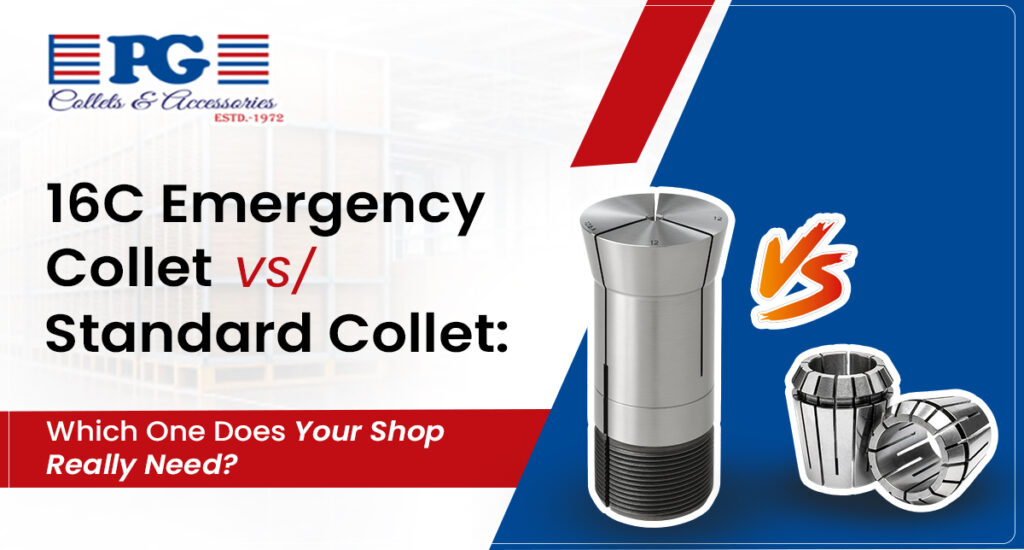
Choosing the right workholding solution is critical for accuracy, efficiency, and productivity in any machine shop. Among the most commonly used options are the 16C Emergency Collet and the Standard Collet. While both serve the same fundamental purpose—securely holding workpieces—their applications, flexibility, and long-term value can differ significantly.
Understanding the strengths and limitations of each collet type can help shop owners and machinists make informed decisions that align with their production needs.
Collets are precision components designed to grip cylindrical or hexagonal workpieces during machining operations. They provide better concentricity, faster setup times, and more uniform clamping compared to traditional chucks.
Both emergency and standard collets are widely used in turning, grinding, and milling applications. However, the choice between them depends on factors such as job volume, part variety, tolerance requirements, and cost considerations.
A Standard Collet is a ready-to-use workholding tool manufactured to fixed internal dimensions. It is designed to hold workpieces of specific sizes within a defined tolerance range.
Standard collets are commonly used in high-volume environments where part dimensions remain constant. Their simplicity and reliability make them a staple in many machine shops.
Because standard collets are factory-finished, they offer excellent concentricity and repeatability. This consistency is crucial for precision machining tasks where tight tolerances must be maintained.
Since no additional machining is required, operators can install and use a standard collet immediately. This saves time during setup and changeovers, especially in production-focused operations.
For shops producing the same parts repeatedly, standard collets are cost-effective. There is no need for customization, which helps keep tooling expenses predictable.
Despite their advantages, standard collets have limitations. Their fixed bore size means they lack flexibility when dealing with non-standard or custom parts. If a job requires a slightly different diameter, a new collet may be needed.
For job shops handling varied or one-off components, relying solely on standard collets can increase tooling inventory and costs over time.
A 16C Emergency Collet is supplied with an undersized or blank bore that can be machined to fit a specific workpiece. This customization allows the collet to match the exact dimensions of the part being held.
Emergency collets are particularly valuable when dealing with special diameters, thin-walled parts, or components requiring exceptional concentricity.
One of the biggest advantages of a 16C emergency collet is its ability to be machined for a perfect fit. This minimizes runout and ensures superior gripping accuracy, even for delicate or irregular components.
Emergency collets are ideal for shops that frequently work on custom jobs or prototypes. A single collet can be modified for different applications, reducing the need for extensive tooling inventories.
Because the bore is machined specifically for the workpiece, clamping pressure is distributed evenly. This reduces the risk of part deformation, making emergency collets suitable for thin or soft materials.
A standard collet is often the better choice when:
In such cases, the reliability and convenience of a standard collet outweigh the need for customization.
A 16C emergency collet is the preferred option when:
Shops that value adaptability and precision often find emergency collets to be a smart long-term investment.
Comparing Cost vs. Value
While a standard collet typically has a lower upfront cost, it may not always offer the best value. For shops dealing with varied job requirements, the ability to customize an emergency collet can reduce the need to purchase multiple fixed-size collets.
In contrast, production-focused shops benefit from the predictability and lower per-part cost of standard collets.
The decision between a 16C Emergency Collet and a Standard Collet depends on your shop’s workflow. Many successful machine shops keep both options available—standard collets for routine jobs and emergency collets for specialized tasks.
This balanced approach ensures readiness for diverse machining challenges without compromising efficiency or accuracy.
Selecting high-quality collets is just as important as choosing the right type. PG Collets focuses on delivering precision-engineered collet solutions designed to meet the demands of modern machining environments. Their products support both production efficiency and customization needs, helping shops maintain accuracy and reliability.
Both standard and emergency collets play essential roles in machining operations. A Standard Collet excels in repetitive, high-volume work, while a 16C Emergency Collet offers unmatched flexibility and precision for custom applications.
By understanding your shop’s requirements and balancing cost with versatility, you can choose the right collet solution that supports productivity, accuracy, and long-term success.