
PG Collets - Quality Collets Manufacturers and Exporters in India and Abroad
Imagine that a single brass fitting moves through four machines, three operators and two inspection checks before it is complete in a shop floor. Take half a million parts multiplied by you, and you can understand why some manufacturers begin searching for a brainier way to work.
The Hydromat Machine is the end of that search. It performs all the tasks on one platform in one continuous cycle rather than breaking a job into a number of parts and running them on a variety of equipment. Let’s take a look at the differences between it and the ones most people are familiar with, and why some of the small details, such as collets, are more important than you realize.
Flexible CNC lathes and mills are ideal for prototypes and custom orders, as well as short runs. This is where the problem begins when volume goes up.
The part must be reloaded, realigned and re-measured every time it moves from one machine to the next. That’s minutes and minutes equal to hours in a production run. Even worse, each re-clamp adds a little bit of difference in positioning, and two pieces that should be mirrored are slightly different.
Traditional systems also require greater manpower and require more space on the floor. The model ceases to be efficient when the volume is high.
The Hydromat Machine is based on a rotary transfer machine layout. Imagine a round table with workstations around the perimeter. The work piece moves from station to station and each station does one operation, such as turning, drilling, slotting, threading or cross-hole work.
What is important is that all the stations operate at the same time. The first tool is cutting a new piece, the last tool is an old piece. A complete part is removed from the machine at each index.
As a result of this overlap, the overall cycle time depends only on the longest operation and not from the sum of all operations. A part with six steps takes half of that. The process takes about as long as the longest step.
Rather than being just a headline-grabbing story, the benefits of speed run run much deeper.
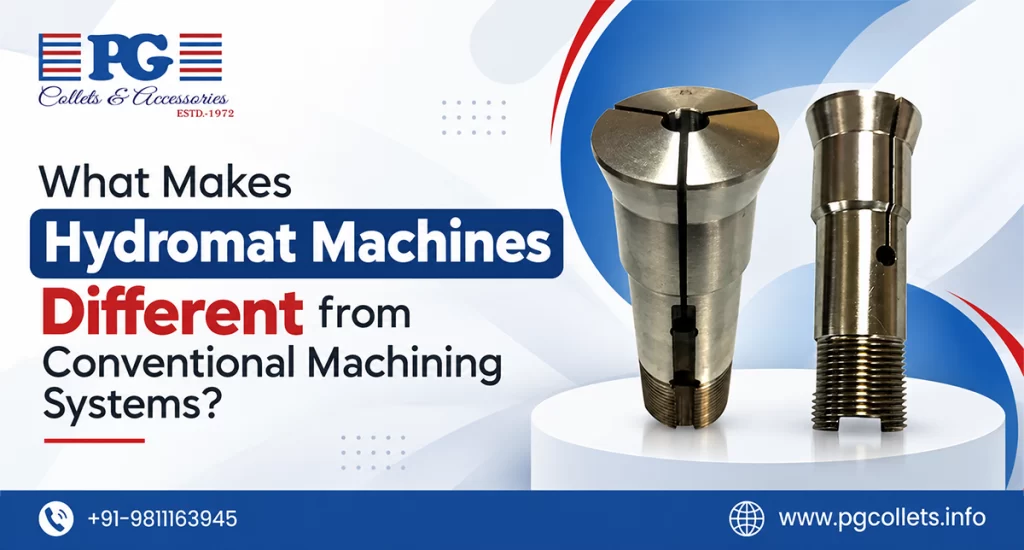
No amount of good brainpower can make up for a bad grip. Hence the importance of Hydromat Machine collets, which are a silent component of the system.
The bar stock is secured into a collet and tools make cuts into the stock. When clamping is uneven, chatter will occur, surface finish will be poor, and dimensions may be out of tolerance. A properly-made collet is used to secure the material in the center and prevents any wobbling, allowing every tool to perform at its peak.
These are some factors to consider when choosing collets:
A level stock also puts less strain on cutting tools which means they last longer and replace fewer tools.
It’s not what you have, it’s what you do with it. Some bad habits can negatively impact it.
The most common cause is running worn collets. Typical slippage and rough finishes will typically appear well before anyone inspects the clamp. Another is to use a collet that is nearly the correct size. A minor difference can lead to run out and lost material.
Not performing routine maintenance on the spindles, coolant lines and transfer mechanisms is as expensive, as one unplanned stop could frost the entire line. Lastly, don’t forget that this system is volume oriented. The setup time could not be worthwhile for a few parts.
The Hydromat Machine is unique in that it combines a series of individual operations into a single synchronized process. You get faster cycles, consistent quality, reduced work rates and reduced footprint. Combine with properly selected Hydromat Machine collets and you have a system that promises accuracy and reliability.
There will always be a place for conventional machining in custom and low volume operations. However, for large scale precision production, a transfer approach is hard to outdo.
Looking to increase the productivity of your production team or find the ideal collets for your machine? Contact PG Collet today to learn more about our products and solutions, and receive expert advice. Visit our website to get started.
1. What is a Hydromat Machine, and how is it different from a conventional CNC machine?
A Hydromat Machine is a rotary transfer machine that moves a workpiece through several stations arranged around a circular table. Each station performs a different operation at the same time. A conventional CNC machine usually completes one or two operations at a time, so parts often need to move between machines. This is why a Hydromat Machine delivers faster cycle times and more consistent results in high-volume production.
2. Why are Hydromat Machine collets so important for precision?
Collets hold the bar stock firmly in place while the cutting tools work on it. If the grip is uneven, you can get chatter, poor surface finish, and parts that fall out of tolerance. High-quality Hydromat Machine collets from PG Collet keep the material centered and steady, so every station can perform accurately from the first part to the last.
3. How do I choose the right collet for my Hydromat Machine?
Start with your material, stock shape, production volume, and tolerance requirements. Soft metals like brass and aluminium need a different clamping force than hardened steel. Round, hexagonal, and square bars each need a matching collet profile. The team at PG Collet can help you select the right size and grade for your specific application.
4. How often should Hydromat Machine collets be inspected or replaced?
Inspect collets regularly, especially during long production runs, because wear builds up gradually. Signs that a collet needs replacing include slippage, rough surface finish, vibration, and inconsistent part dimensions. Replacing worn collets early prevents scrap, protects your cutting tools, and avoids unplanned downtime.
5. Is a Hydromat Machine suitable for low-volume production?
Not usually. A Hydromat Machine is designed for high-volume, repeatable production, where its fast cycle times and low cost per piece make the setup effort worthwhile. For small batches, prototypes, or custom jobs, conventional CNC machining is often the more practical choice.