
PG Collets - Quality Collets Manufacturers and Exporters in India and Abroad
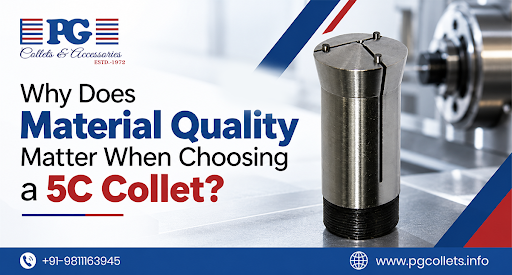
For precision manufacturing, a component’s dimensions may be impacted by slight variations in workholding. If the collet wears out too rapidly, does not secure the workpiece properly or if it does not align it properly, it can cause dimensional errors, surface finish problems, and unnecessary production delays. Hence, the quality of materials is certainly an important aspect to consider when selecting a 5C Collet for industrial use.
A 5C collet is a type of collet that is generally used in compatible lathes, grinding machines, and other types of work holding setups to grip cylindrical workpieces securely. But not every collet is as durable, grips or resists wear as much. The type of material used in the manufacture of the collet may affect the performance characteristics of the collet under various operating conditions.
The physical properties of the material of which a collet is made have a direct effect on the strength, resistance to wear, dimensional stability and ability of a collet to grip a work piece in a consistent manner.
Collets might be subjected to multiple clamping cycles, rubbing, vibration, and contact with metal parts in industrial applications. A suitable material can allow the collet to resist these conditions, and keep its shape and function as intended.
Manufacturers should consider the quality of the material in addition to dimensions, heat treatment, manufacturing tolerances, and machine compatibility.
Many of the industrial 5C collets are produced from appropriate alloy or tool steels, which will offer the strength and wear resistance needed for repeated machining operations.
But if you choose steel, it doesn’t ensure good performance. The manufacturing process and heat treatment are also significant factors.
The correct heat treatment can ensure the required hardness and mechanical properties. A too-soft collet can have its gripping surfaces worn out early. When the material properties are an inappropriate match for the design, it can be prone to cracking or other types of damage.
Careful dimensional inspection and precision grinding are also vital. A good quality collet, even if constructed from steel may not function well if it is not dimensioned properly internally, in terms of taper or the gripping surface.
For instance, if you are working with metal shafts in large quantities, a collet that can consistently grip the shaft in the same manner, every time, would be beneficial. To achieve that objective, factors such as material quality, proper heat treatment and precise manufacturing must be taken into account.
Buyers should look at the entire manufacturing process and NOT simply by the material description of a 5C Collet.
There’s no one-size-fits-all solution for all workholding applications. Some work involves delicate and polished or easily marked parts which require special attention when clamping.
For some specific applications, a machinable brass workholding part may be desired and a Brass Emergency 5C Collet may be suitable. Specific workpiece dimensions or profiles can be modified using emergency collets, depending on the design and manufacturer’s directions.
Brass is typically less rigid than hardened steel, and may be useful where reducing the likelihood of marking specific work surface is significant. But its usefulness is determined by the gripping force, machining loads, material of the work-piece, and operating conditions.
Here are a few things to keep in mind when deciding on a brass emergency collet:
Brass is not always the most suitable choice for a delicate part. The final selection should depend on the particular application and on the limitations of the design of the collet.
Second operation machining can be the secondary process performed after the first process, such as producing other features on a component. These can be facing operations, drilling, chamfering, threading or finishing operations.
A 5C Collet Second Operation Machines to offer appropriate workpiece support in order to perform the second operation accurately.
It is important that material quality is correct, as repeated loading and unloading can have an impact on the gripping surfaces of the material. An appropriate collet also needs to be of the correct size for the piece of work and the machine.
A manufacturer that has turned a part but is just about to remove it from the lathe may have to ensure that a part’s existing feature is related to a newly machined surface at a fixed location. The repeatability can be supported by the use of an accurately made collet having suitable material properties.
If using a collet for second operation work, the following will be checked:
The checks will eliminate unnecessary setup issues and contribute to a more consistent machining process.
When a standard collet will not have a proper gripping profile for a specific application, a 5C Emergency Collet is frequently chosen. As per the design, it could be adjusted for making it fit a certain part or specialised machining requirement.
When choosing one to buy, consider the bigger picture. Overall value depends on the suitability of the material, the precision of the manufacturing process, the customization needs, and the anticipated life.
Discuss the material specifications, heat treatment (if applicable), dimensional tolerances, and compatibility with your equipment with the supplier. For applications that require application of non-standard components, the drawing or dimensions of the workpiece must be provided accurately.
A regular inspection schedule should be established as well. The performance of workholding can be compromised by any of a variety of factors, including chips, contamination, excessive wear or improper clamping pressure, and regardless of material.
A properly fitted collet and proper maintenance can result in trouble-free operation and fewer unnecessary machining interruptions.
The quality of the material is a key factor in the functionality, longevity and uniformity of the 5C Collet. A combination of appropriate material characteristics, heat treatment, part dimensional tolerances and manufacturing quality are conducive to reliable work holding in precision machining applications.
It is worthwhile to consider all of these factors to ensure you pick a collet that works for you and your actual machining tasks without extra replacement or production delays.
Need some appropriate collets for your machining? Contact PG Collets and discover industrial collet solutions and talk about your workholding needs. Select a product according to machine compatibility, component specifications and application requirements.
1. Why does material quality matter when choosing a 5C Collet?
Material quality directly affects a collet’s strength, wear resistance, dimensional stability, and grip. A poor-quality collet can wear out quickly, slip during machining, or fail to hold the workpiece in the correct position. This can lead to dimensional errors, poor surface finish, and unnecessary production delays.
2. What role does heat treatment play in a 5C Collet?
Heat treatment gives the collet the right hardness and mechanical properties for repeated machining. A collet that is too soft can have its gripping surfaces wear out early, while one with poorly matched properties may crack or get damaged. Precision grinding and careful dimensional inspection are equally important for consistent performance.
3. When should I use a Brass Emergency 5C Collet?
A Brass Emergency 5C Collet is a good option when you are working with delicate, polished, or easily marked parts. Brass is generally less rigid than hardened steel, which can help reduce marking on the workpiece surface. However, you should also check the gripping force, machining loads, and workpiece material before choosing it.
4. Why is a 5C Collet for second operation machines important?
Second operation machining includes tasks such as facing, drilling, chamfering, threading, and finishing. A properly sized and well-made 5C collet supports the workpiece accurately, helping new features line up correctly with existing ones. Good material quality also matters because repeated loading and unloading can wear the gripping surfaces.
5. What should I consider before buying a 5C Emergency Collet?
Look at material specifications, heat treatment, dimensional tolerances, customization needs, and compatibility with your machine. For non-standard applications, provide accurate drawings or workpiece dimensions to the supplier. Regular inspection for chips, contamination, and wear will also help keep performance consistent. PG Collets can help you select the right option for your workholding needs.